
Financial knowledge is the understanding of how everyday money decisions work, including earning, spending, saving, borrowing, investing and preparing for longer-term needs. Strong financial knowledge helps you understand your options, compare information and ask better questions before making important decisions.
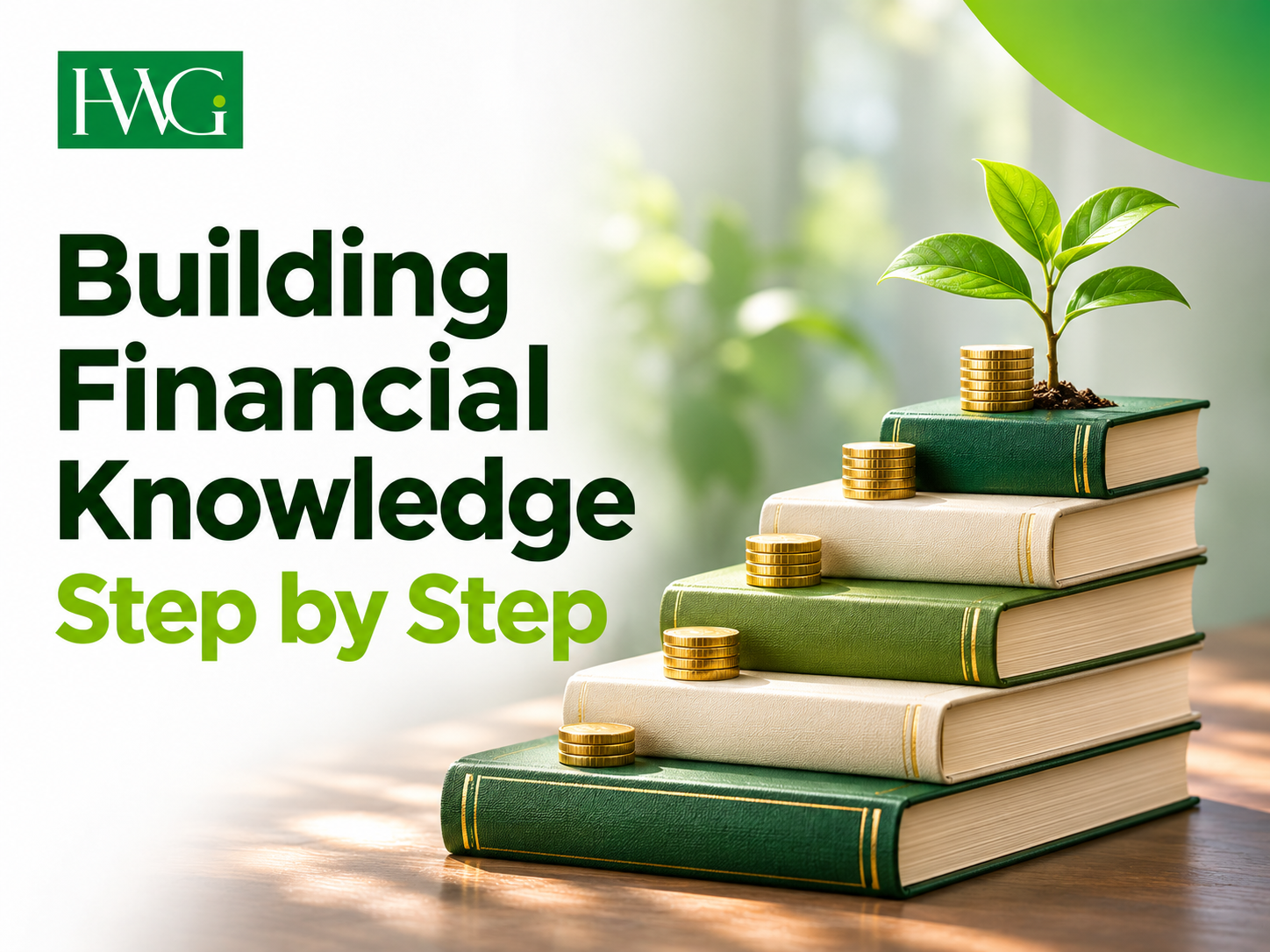
Financial knowledge building works best as a gradual learning process. You can begin with your current income and expenses, then move into budgeting, debt, emergency savings, credit, investing, financial risk protection and estate matters. For a broader introduction, see HWG Asia’s guide to financial literacy in Malaysia.
What Is Financial Knowledge?

Financial knowledge refers to understanding important financial facts, concepts, and processes and knowing how they relate to real-life decisions. This includes understanding how interest affects borrowing, how inflation affects purchasing power, why liquidity matters, and what risks should be considered before making a financial commitment.
The US Consumer Financial Protection Bureau (CFPB) explains that financial knowledge and decision-making skills involve understanding financial concepts, evaluating available information, solving financial problems, and making informed financial decisions.
Knowing a term is only the first stage. Stronger financial knowledge means understanding how the concept works and knowing what questions to ask before acting.
Financial Knowledge vs Financial Literacy
Financial knowledge and financial literacy are closely related, but they are not exactly the same.
| Area | Financial Knowledge | Financial Literacy |
| Main focus | Understanding financial concepts and processes | Understanding and applying financial knowledge |
| Example | Knowing how interest affects a loan | Comparing borrowing costs before taking a loan |
| Investment example | Understanding risk and diversification | Using that understanding when evaluating options |
| Goal | Build understanding. | Support informed financial behaviour and decisions. |
Financial knowledge therefore forms part of broader financial literacy. Malaysia’s National Strategy for Financial Literacy 2026-2030 also looks beyond knowledge alone and covers financial planning, debt management, risk protection, digital financial services, and investment awareness.
Readers who want a wider introduction can also explore financial education in Malaysia.
How to Build Financial Knowledge Step by Step

There is no single learning sequence that suits everyone. A practical approach is to begin with areas that affect everyday money management before progressing to subjects involving greater complexity and longer-term consequences.
Step 1: Understand Your Cash Flow
Start by understanding how much money comes in and where it goes each month. Record income, essential expenses, debt repayments, savings, and discretionary spending.
The purpose is to identify your current position before changing anything. Knowing whether you regularly have a surplus or shortfall gives context to later decisions about saving, borrowing, and longer-term goals.
Cash-flow management is also one of the foundational topics covered in Malaysia’s EPF Financial Literacy Hub.
Step 2: Build a Realistic Budget
A budget turns your cash-flow information into a spending plan. It can divide income across essentials, commitments, savings and discretionary expenses according to your circumstances.
Percentage-based methods such as 50/30/20 can be useful educational examples, but they are not rules that fit every household. Housing costs, dependents, income level, and existing commitments can change what a realistic allocation looks like.
The key is to understand where your money is allocated and review the budget when your circumstances change.
Step 3: Understand Debt Before Taking on More
Debt knowledge starts with understanding the balance owed, interest or profit rate, monthly repayment, remaining term and total borrowing cost.
Different debts have different structures and consequences. Before taking on additional borrowing, understand how the repayment fits alongside existing commitments and what happens if payments are missed.
Individuals experiencing financial difficulties or struggling with debt repayments can seek guidance and relevant financial counselling services from Agensi Kaunseling dan Pengurusan Kredit.
Step 4: Build Knowledge About Emergency Savings
Emergency savings provide accessible money for unexpected expenses or temporary income disruption. They should be considered separately from money intended for longer-term objectives.
PIDM uses six months of expenses as a reference point in its Emergency Savings Calculator. However, individuals should assess their emergency savings targets according to their essential expenses, income stability, financial commitments, and family responsibilities.
The important lesson is to understand why liquidity matters. Emergency money needs to be accessible when an unexpected expense occurs.
Step 5: Understand Credit, Risk and Financial Scams

Learning about credit involves more than knowing your credit score. Malaysians can access their CCRIS report through Bank Negara Malaysia’s eCCRIS service to review financing and repayment information reported by participating financial institutions.
A CCRIS report provides information on an individual’s credit facilities and repayment records reported by participating financial institutions, generally covering the preceding 12 months. Bank Negara Malaysia clarifies that CCRIS is not a blacklist or a credit rating system. Instead, it provides credit information that financial institutions may consider when assessing financing applications.
Financial knowledge also involves verifying claims before transferring money. For capital-market activities, the Securities Commission Malaysia’s Investment Checker allows the public to verify whether an individual or entity is authorised by the SC to offer, promote or sell capital-market products and services.
Step 6: Learn Investment Fundamentals Before Evaluating Products
Investment education should begin with basic concepts rather than individual product selection. Learn how risk and potential return relate to each other and understand concepts such as diversification, fees, liquidity, and investment time horizon.
Regulatory authorisation does not eliminate investment risk or guarantee returns. Investors should still assess the product’s features, risks, fees and suitability before making any investment decision, and avoid making decisions based only on promotional returns or social media claims.
Malaysia’s National Strategy for Financial Literacy 2026-2030 specifically includes investment awareness as one of its five strategic priorities, alongside retirement preparation, debt management, financial risk protection, and digital financial safety.
Step 7: Understand Financial Risk Protection
Financial knowledge also includes understanding how unexpected events may affect household income and savings. This means learning basic concepts such as coverage, exclusions, premiums or contributions, waiting periods, benefit limits, and beneficiary arrangements before considering any protection product.
Deposit protection is another concept worth understanding. PIDM protects eligible deposits placed with member banks up to RM250,000 per depositor per member bank. Eligible conventional and Islamic deposits are protected separately, each subject to the applicable RM250,000 limit and PIDM’s protection rules. Certain deposit categories and account arrangements may have specific eligibility requirements. Learn how PIDM deposit protection works.
This does not mean every financial product is protected by PIDM. Investment products, for example, generally fall outside the deposit insurance system.
Step 8: Learn Estate Planning and Wealth Transfer Basics
Financial knowledge should eventually include understanding what may happen to assets when an owner dies. Estate matters may involve wills, nominations, trusts, beneficiary arrangements, property ownership, and business succession.
Different structures serve different purposes.
| Structure | Basic function |
| Will | Records instructions relating to the administration and distribution of applicable estate assets after death |
| Nomination | Identifies a nominated person or institution in accordance with the specific rules governing the relevant financial asset or account. The legal effect of a nomination may differ depending on the asset type and applicable rules. |
| Trust | Sets terms for holding and administering specified assets for beneficiaries |
| Business succession arrangement | Addresses future ownership, leadership or continuity of a business. |
Business owners should also distinguish personal estate planning from business succession arrangements, as transferring personal assets and maintaining business ownership or operations may involve different legal and financial considerations.
These arrangements should not automatically be treated as interchangeable. For example, EPF explains that nomination arrangements differ between Muslim and non-Muslim members. Readers can review the official EPF nomination guidance.
For a broader educational overview, HWG Asia’s guide to generational wealth planning in Malaysia explains how asset inventories, beneficiaries, succession and estate considerations can fit together.
Readers interested specifically in trusts can also review the educational guide to family trusts in Malaysia.
How to Keep Building Financial Knowledge

Financial knowledge changes as your circumstances and responsibilities change. Set a regular time to review what you understand about your cash flow, debt, savings, credit, retirement arrangements, and estate documents.
A review is particularly useful after major changes such as marriage, a new child, a job change, property purchase, new debt, business ownership, or approaching retirement.
For longer-term preparation, HWG Asia’s educational guide on how to plan for retirement in Malaysia provides further information on EPF, retirement expenses, and retirement savings benchmarks.
Financial knowledge also needs reliable sources. Prioritize information from regulators, government agencies, and established educational organisations, especially when rules, limits or product features can change.
Where Can Malaysians Learn Financial Knowledge?

Malaysians have access to several official financial education resources. The EPF Financial Literacy Hub includes articles, videos, e-learning modules, and other materials covering topics such as cash flow, credit, debt, investment, inflation, and retirement. EPF also launched public financial-literacy e-learning modules in May 2026.
The Financial Education Network’s National Strategy for Financial Literacy 2026-2030 provides the wider national framework for improving financial knowledge, behavior, and resilience. Bank Negara Malaysia, the Securities Commission Malaysia, PIDM, and AKPK also provide official resources covering credit, investment verification, savings, debt and financial safety.
Using primary sources becomes increasingly important as the topic becomes more technical. Rules, thresholds and regulatory requirements can change, so current official information should take priority over old articles or social media posts.
Frequently Asked Questions About Financial Knowledge Building
Q1: How do you build financial knowledge?
A: Start with your current cash flow and budget, then build your understanding of debt, emergency savings, credit, investment risk, financial protection and estate matters. Apply each concept to real-life examples and use reliable sources to check your understanding.
Q2: What is the difference between financial knowledge and financial literacy?
A: Financial knowledge refers mainly to understanding financial concepts and processes. Financial literacy is broader because it includes the ability to apply that knowledge when making financial decisions.
Q3: How much emergency savings should you have?
A: There is no amount that suits every household. PIDM uses six months of expenses as a reference in its emergency savings tools, but the appropriate target depends on expenses, commitments, income stability and family circumstances.
Q4: Where can Malaysians learn about personal finance?
A: Malaysians can start with official educational resources from EPF’s FinLit Hub, Bank Negara Malaysia, the Securities Commission Malaysia, PIDM, AKPK, and the Financial Education Network. These sources cover areas including budgeting, debt, credit, investments, scams, retirement and financial resilience.
Q5: Why should you learn investment basics before considering an investment?
A: Basic investment knowledge helps you understand risk, potential return, fees, liquidity and time horizon before evaluating an opportunity. It also helps you identify the information that should be verified with regulators such as the Securities Commission Malaysia.
Build Financial Knowledge One Step at a Time
Financial knowledge building is an ongoing learning process rather than a single course or financial decision. Start with the areas that affect everyday money management, then gradually learn about longer-term topics such as investments, retirement, and estate matters.
The goal is to understand financial information well enough to ask informed questions and recognize when additional professional or regulated expertise is required. For more educational resources, continue with HWG Asia’s guide to financial education in Malaysia.
Continue Building Your Financial Knowledge with HWG Asia.
Building financial knowledge takes time and regular learning. Explore HWG Asia’s educational resources on financial literacy, retirement planning, estate planning and generational wealth to strengthen your understanding of key financial topics.
Take the Next Step
Contact HWG Malaysia Today
Got Inquiries? Please contact us or start a Conversation with HWG Greenie, our AI chatbot.
Visit and follow Our Social Media:
Website: https://www.hwg.asia/
Facebook: https://www.facebook.com/hwg.asia
LinkedIn: https://www.linkedin.com/company/hwgasia/
Visit Our Office:
Address: 42, Jalan BM1/2, Taman Bukit Mayang Emas, 47301 Petaling Jaya, Selangor
Email: customerservice@hwg.asia
Phone: 03-5569 9834
Download the HWG Go Apps (Available on the Play Store and App Store)

HWG Go: Available on both the Google Play Store and Apple App Store (T&C Available).
Disclaimer:
This article, published on this website, may be written or contributed by subject-matter experts or external writers. They are intended for general information and educational purposes only. HWG does not guarantee the accuracy, completeness, or timeliness of the information provided. Please note that the products, services or solutions in these articles may not be offered or provided by HWG. HWG shall not be held responsible or liable for any loss, damage, or issues arising from the use of, or reliance on such information.