
Understanding the financial literacy meaning helps you manage money, make informed financial decisions, and prepare for future expenses. In 2026, Malaysians face changing household costs, borrowing commitments, and increasing access to digital financial services. Developing financial knowledge helps you manage these responsibilities through responsible spending, saving, and planning habits.
What Is Financial Literacy? Meaning and Simple Explanation

Financial literacy means understanding how to manage income, expenses, savings, debt, and investments effectively. It involves applying financial knowledge to everyday decisions, including preparing budgets, comparing loan costs, and planning for emergencies. For example, understanding interest rates helps you compare total borrowing costs before accepting a loan.
According to the OECD’s financial education framework, it describes financial literacy as a combination of financial awareness, knowledge, skills, attitudes, and behaviours needed to make sound financial decisions and ultimately achieve individual financial well-being. Understanding financial concepts provides a foundation, while applying them through everyday actions develops financial capability. Explore HWG Asia’s financial literacy guide for Malaysia for further information about local financial education.
What Are the 7 Main Components of Financial Literacy?
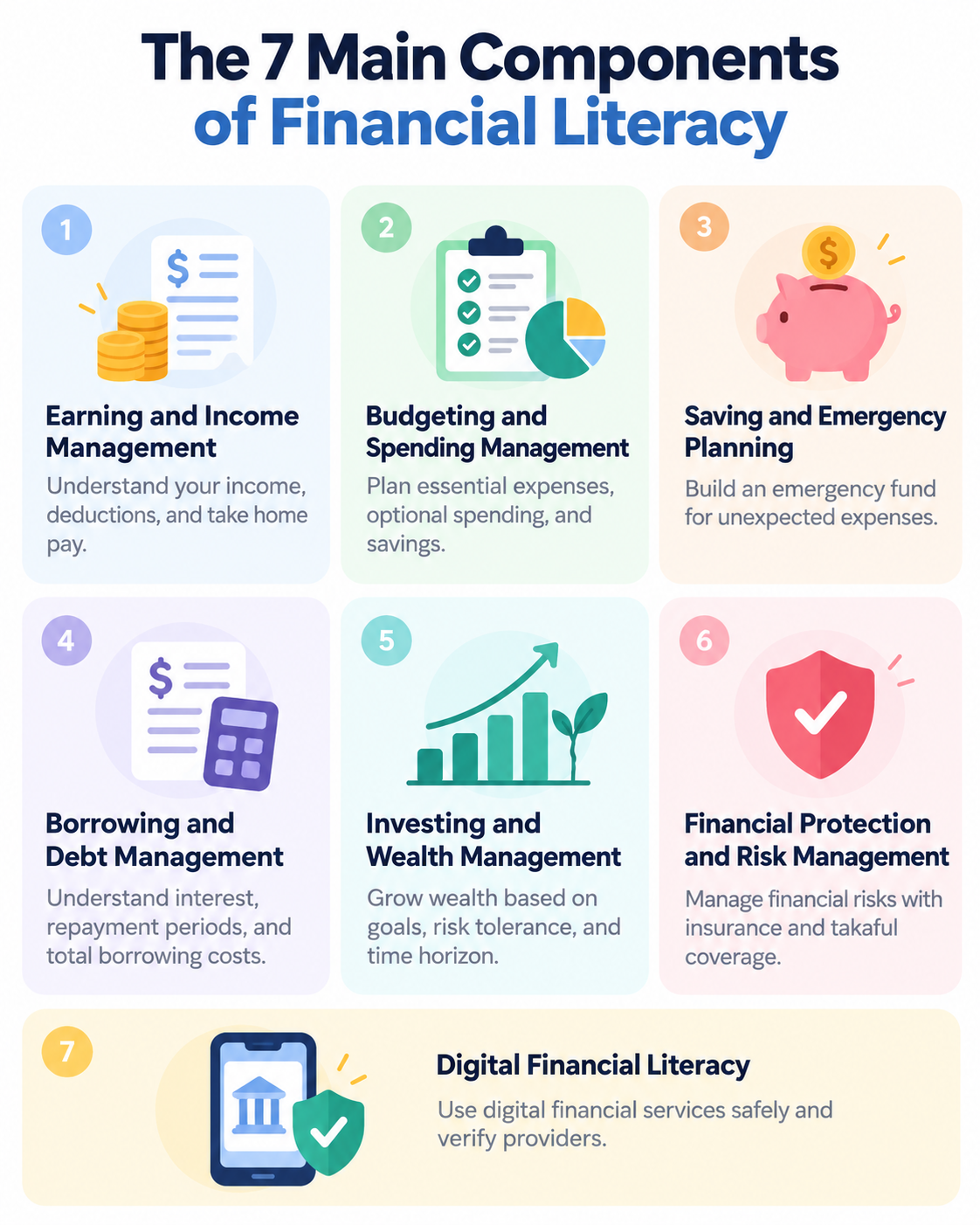
The seven main components of financial literacy are income management, budgeting, saving, debt management, investing, financial protection, and digital financial literacy. These categories form a practical educational framework for understanding personal finance. Each component addresses an important aspect of managing everyday expenses and preparing for future financial responsibilities.
1. Earning and Income Management
Income management involves understanding your earnings and the amount available after deductions. For Malaysian employees, deductions such as employee EPF contributions, applicable SOCSO and EIS contributions, and monthly tax deductions (PCB) affect take-home pay. Understanding these deductions helps employees calculate their actual disposable income. Review your payslip to identify your actual income before preparing a budget. Use this amount to calculate how much money remains for expenses, debt repayments, and savings.
2. Budgeting and Spending Management

Budgeting helps you organise income according to essential expenses, optional purchases, and savings goals. Essential expenses include housing, groceries, and transportation, while optional spending covers shopping, dining, and entertainment. The 50/30/20 budgeting method provides an illustrative starting point for dividing income between needs, wants, and savings. However, the percentages should be adjusted according to individual income levels, living expenses, and financial commitments.
3. Saving and Emergency Financial Planning
Emergency savings help you manage unexpected expenses without immediately relying on credit cards or personal loans. A commonly used financial planning guideline suggests building emergency savings equivalent to three to six months of essential living expenses. However, the appropriate target depends on income stability, financial commitments, dependants, and individual circumstances. If your essential monthly expenses total RM2,000, your emergency fund target would fall between RM6,000 and RM12,000. Schedule a transfer into a separate savings account each payday to build your emergency fund consistently.
4. Borrowing and Debt Management
Debt management involves understanding interest rates, financing charges, repayment periods, and outstanding balances. Before accepting financing, compare total repayment costs rather than focusing only on monthly installments. Longer repayment periods often reduce monthly payments while increasing overall borrowing costs. HWG Asia’s guide to financial control and debt recovery explains practical approaches to reviewing commitments and managing outstanding debt.
5. Investing and Wealth Management
Investing involves allocating money to assets such as shares, bonds, or investment funds with the aim of generating future returns. Your investment choices should reflect your financial goals, investment period, and ability to accept losses. Money needed for immediate expenses generally requires greater attention to liquidity and short-term risks. Understanding investment diversification strategies helps you manage exposure to individual investments, although financial losses remain possible.
6. Financial Protection and Risk Management
Financial protection helps reduce the financial impact of unexpected events affecting your health, property, or income. Insurance and takaful products provide coverage for eligible situations according to their policy terms. Before selecting financial protection, compare coverage limits, exclusions, and payment obligations. For example, medical insurance might exclude certain treatments, leaving you responsible for expenses outside your coverage.
7. Digital Financial Literacy

Digital financial literacy involves using online banking, electronic wallets, and investment platforms safely. Protect your banking credentials, enable additional account security features, and review financial transactions regularly. Before transferring money to unfamiliar investment providers, check the Securities Commission Malaysia Investor Alert List and use its Investment Checker to verify whether the individual or entity is authorised to offer the relevant capital-market products or services. Being absent from the alert list does not automatically establish that a provider is authorised or legitimate. HWG Asia also explains how digital wealth management in Malaysia influences access to investment services and financial platforms.
Why Is Financial Literacy Important in 2026?
Financial literacy matters in 2026 as Malaysian households manage living expenses, borrowing commitments, and expanding digital financial services. Changes in grocery prices, transportation expenses, and housing costs affect how much income remains for savings. Understanding how inflation affects financial planning helps you review spending priorities and maintain realistic financial goals.
Digital borrowing services introduce additional repayment responsibilities. For example, someone using several Buy Now, Pay Later arrangements might overlook the combined monthly installments when tracking purchases separately. Calculating total repayment commitments before accepting additional financing helps you assess affordability and protect money intended for essential expenses.
Malaysia’s National Strategy for Financial Literacy 2026 to 2030 focuses on strengthening financial resilience across different life stages. Its five priorities cover financial planning and retirement, responsible debt management, financial risk protection, safe digital financial participation, and investing for wealth creation. Reviewing your income, outstanding debt, and financial protection provides a practical starting point for applying these principles.
Financial Literacy Example in Everyday Life

Alt text: Person dividing monthly income between expenses, personal spending and savings
Consider a Malaysian employee earning RM4,000 in monthly take-home income. Using the 50/30/20 budgeting method, the employee allocates RM2,000 to essential expenses, RM1,200 to personal spending, and RM800 to savings and financial goals. This allocation helps organise monthly spending while reserving money for future needs.
The employee transfers RM400 from the savings allocation into an emergency fund every month. After twelve months, the fund would contain RM4,800, excluding interest and assuming no withdrawals. This amount covers approximately 2.4 months of essential expenses, demonstrating how consistent saving contributes towards an emergency fund.
How to Improve Your Financial Literacy Skills

Start by reviewing your bank transactions from the previous 30 days and separating essential expenses from optional purchases. Create a monthly budget based on your take-home income and establish a realistic savings target. Spend ten minutes each week checking your expenses against your budget to identify spending habits that require adjustment.
Before selecting financial products, compare borrowing costs, investment risks, and insurance or takaful coverage. Review repayment conditions, product fees, and the regulatory status of financial providers before making commitments. Continue developing your financial knowledge through credible financial education resources and regular reviews of your financial goals.
Frequently Asked Questions About Financial Literacy
Q1: What is financial literacy in simple terms?
Financial literacy means understanding how to earn, spend, save, borrow, and invest money responsibly. These skills help you manage everyday expenses and prepare for unexpected financial situations. Creating a monthly budget is one practical example of applying financial literacy.
Q2: What are the 7 components of financial literacy?
The seven components are income management, budgeting, saving, debt management, investing, financial protection, and digital financial literacy. Each component addresses an important aspect of managing personal finances. Together, these areas provide a practical framework for developing financial knowledge.
Q3: What is the main goal of financial literacy?
The main goal of financial literacy is to help individuals make informed financial decisions and improve financial well-being. Financial knowledge supports responsible spending, effective debt management, and preparation for future expenses. Applying these skills helps reduce avoidable financial mistakes.
Q4: What is another term for financial literacy?
Financial knowledge and financial capability are closely related terms associated with financial literacy. Financial knowledge focuses on understanding financial concepts, while financial capability involves applying those concepts through responsible financial behavior. Financial education supports the development of both knowledge and practical skills.
Start Improving Your Financial Literacy Today
Review your latest bank statement and identify one expense you want to reduce. Establish a monthly savings target and schedule a transfer into your savings account each payday. Review your spending and financial commitments regularly to strengthen your money management habits.
Continue Building Your Financial Literacy with HWG Asia
Improving financial literacy starts with consistent learning and better awareness of everyday money decisions. Explore HWG Asia’s educational resources on budgeting, debt, retirement planning, estate planning and financial knowledge to continue building your understanding.
Take the Next Step
Contact HWG Malaysia Today
Got Inquiries? Please contact us or start a Conversation with HWG Greenie, our AI chatbot.
Visit and follow Our Social Media:
Website: https://www.hwg.asia/
Facebook: https://www.facebook.com/hwg.asia
LinkedIn: https://www.linkedin.com/company/hwgasia/
Visit Our Office:
Address: 42, Jalan BM1/2, Taman Bukit Mayang Emas, 47301 Petaling Jaya, Selangor
Email: customerservice@hwg.asia
Phone: 03-5569 9834
Download the HWG Go Apps (Available on the Play Store and App Store)

HWG Go: Available on both the Google Play Store and Apple App Store (T&C Available).
Disclaimer:
This article, published on this website, may be written or contributed by subject-matter experts or external writers. They are intended for general information and educational purposes only. HWG does not guarantee the accuracy, completeness, or timeliness of the information provided. Please note that the products, services or solutions in these articles may not be offered or provided by HWG. HWG shall not be held responsible or liable for any loss, damage, or issues arising from the use of, or reliance on such information.