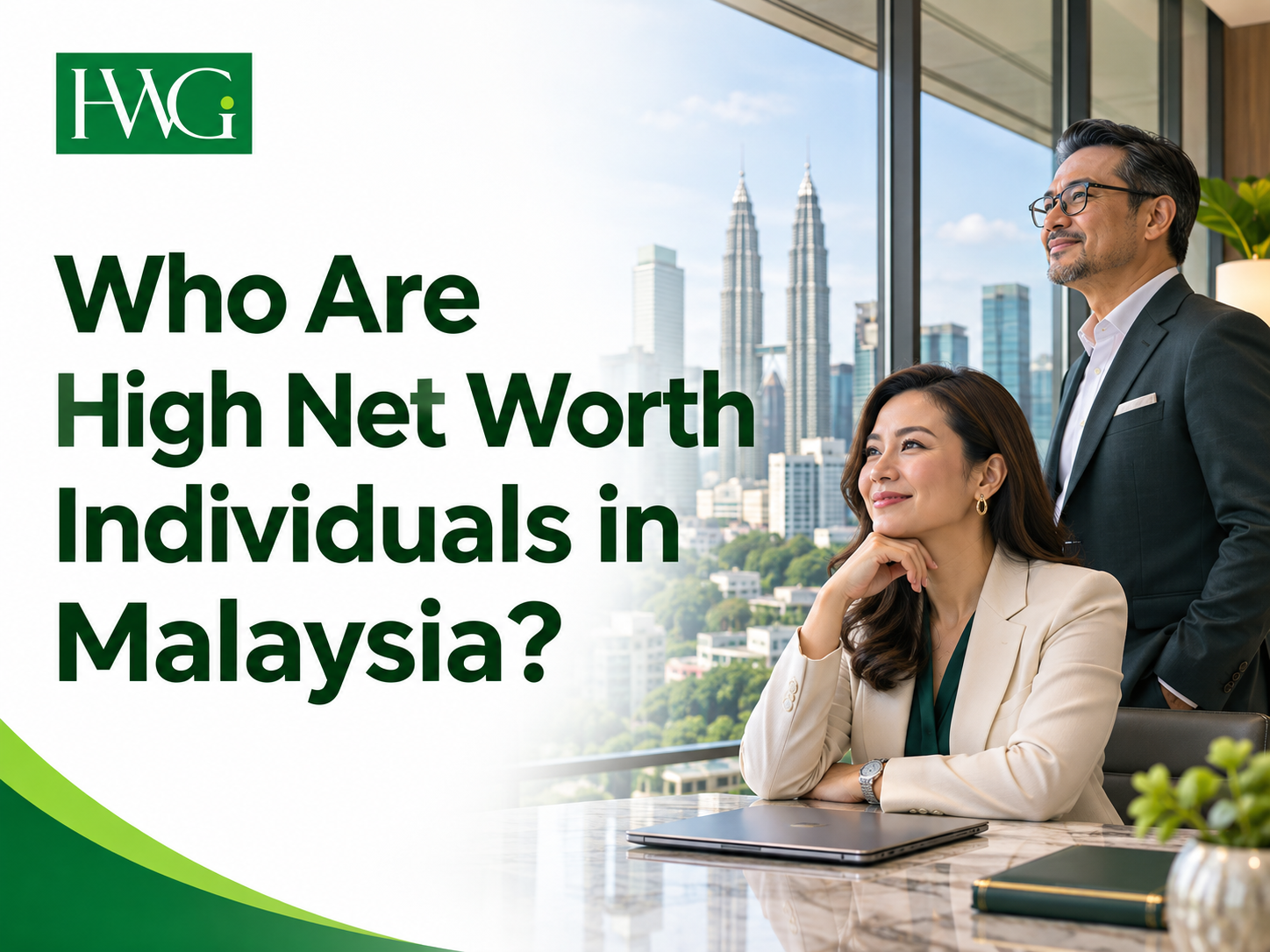

High net worth individuals in Malaysia generally refer to people with substantial personal wealth, which may include property, business interests, financial assets, and other holdings. For Malaysian capital-market purposes, the Securities Commission Malaysia also sets specific criteria under its sophisticated investor framework.
Under the current SC Guidelines on Categories of Sophisticated Investors, the High-Net Worth Individual category includes financial thresholds based on assets, income, and capital-market investment portfolios, together with specified knowledge and experience criteria. This regulatory definition should be distinguished from the broader way banks, researchers, or wealth reports may use the term HNWI.
As personal and family assets become more complex, questions may also arise around ownership, inheritance, business succession, beneficiaries, and family governance. These are separate planning issues and do not depend solely on whether someone meets an HNWI threshold.
What Is a High Net Worth Individual in Malaysia?

A high net worth individual, or HNWI, generally refers to someone with substantial personal wealth accumulated through sources such as business ownership, employment income, property, investments, or inheritance.
Net worth is calculated by subtracting liabilities from total assets. For example, a person with RM4 million in assets and RM800,000 in liabilities has a net worth of RM3.2 million.
For Malaysian securities-law purposes, the SC uses specific HNWI criteria as part of its sophisticated investor framework. These regulatory thresholds should not be treated as a universal definition used by every institution or for every purpose.
How Much Is Considered High Net Worth in Malaysia?

Under the SC’s current sophisticated-investor guidelines, an individual can fall within the HNWI category by satisfying one of several prescribed criteria.
| Financial criterion | SC threshold |
| Total net personal assets | Exceeding RM3 million |
| Total net joint assets with spouse or child | Exceeding RM3 million |
| Individual gross annual income | Exceeding RM300,000 in the preceding 12 months |
| Joint gross annual income with spouse or child | Exceeding RM400,000 in the preceding 12 months |
| Net personal or qualifying joint capital-market investment portfolio | Exceeding RM1 million |
For the RM3 million asset criterion, the net value of the individual’s primary residence may contribute no more than RM1 million toward the qualifying amount. This limitation applies to both individual assets and qualifying joint assets. The SC’s framework also includes specified qualifications, professional memberships, and relevant work experience as additional sophisticated-investor criteria.
These criteria apply within the SC’s regulatory framework. They should not be interpreted as a universal measure of whether someone is financially wealthy in every commercial or personal context.
HNWI vs UHNWI vs Sophisticated Investor in Malaysia
These terms describe different concepts and should not be used interchangeably.
| Classification | What it generally means |
| High Net Worth Individual | A person with substantial wealth or someone meeting applicable HNWI criteria |
| Ultra High Net Worth Individual | A market term used by wealth-research organisations for individuals at a significantly higher wealth level |
| Sophisticated Investor | A regulatory classification under Malaysian securities rules |
The SC’s sophisticated-investor framework has a specific regulatory purpose. It determines which individuals or entities meet prescribed criteria in relation to certain capital-market products and activities.
The framework is also broader than wealth alone. The SC’s guidelines, first issued in February 2024, also recognise certain academic qualifications, professional memberships, and relevant work experience as criteria for qualifying as a sophisticated investor. This means financial wealth and regulatory sophistication are related concepts, but they are not identical.
Who Are the Richest Individuals in Malaysia?
Malaysia’s richest individuals and families represent a much smaller group than the wider HNWI population. Forbes’ Malaysia’s 50 Richest 2026 list estimated their combined wealth at US$116 billion.
According to the April 2026 ranking, Robert Kuok ranked first with an estimated net worth of US $13.6 billion, followed by Koon Poh Keong and his siblings at US $9.7 billion and Lee Yeow Chor and Lee Yeow Seng at US$8.5 billion. View Forbes Malaysia’s 50 Richest 2026
These rankings should not be treated as the definition of an HNWI in Malaysia. Many people may satisfy SC HNWI criteria without appearing on a public rich list.
What Planning Issues Do HNWIs Commonly Face?
Higher levels of wealth often mean that ownership and succession become more complex. An individual may hold company shares, several properties, financial assets and interests in family businesses, with different beneficiaries or responsibilities attached to each asset.
The important question is therefore not simply how much someone owns. Families also need to understand who owns each asset, what liabilities exist, what happens when ownership changes, and who will be responsible for future decisions.
Business Ownership and Succession
For business owners, personal wealth may be closely connected to company shares and business value. This can create questions about future ownership, leadership, and the role of family members who are not involved in daily operations.
The educational guide on business succession planning in Malaysia explains how ownership, governance, and leadership continuity can be reviewed as separate issues.
Estate and Beneficiary Arrangements
Different assets may follow different transfer processes when an owner dies. Property, company shares, trust assets, nominations, and other holdings should therefore not automatically be treated in the same way.
Families exploring this area can read HWG Asia’s guide to generational wealth planning in Malaysia, which covers asset inventories, succession, beneficiaries, governance, and preparation for future generations.
Complex Assets and Family Responsibilities
The more diverse a family’s assets become, the more important clear documentation and responsibilities become. Property may involve mortgages or joint ownership, while company shares may involve shareholder agreements, voting rights, or management responsibilities.
Families may also need to distinguish between ownership and management. A person who inherits an economic interest in a business does not necessarily need to manage its daily operations.
How Private Trusts Can Be Used in Estate Planning

A private trust is a legal arrangement under which specified assets are held and administered by a trustee for designated beneficiaries in accordance with the terms of a trust deed. Depending on its structure and applicable law, a trust may establish rules covering matters such as beneficiary distributions, education funding, or longer-term asset administration.
For example, a trust may state that specified funds are available for a beneficiary’s education or living needs over a defined period rather than being distributed as one lump sum.
A trust should not be viewed as automatically suitable for every HNWI. Trustee responsibilities, fees, asset ownership, beneficiary needs, tax treatment, and legal requirements should be considered before any structure is established. To understand the concept further, you can review HWG Asia’s educational guides to family trusts in Malaysia and private trust companies in Malaysia.
A private trust and a private trust company are also different. A trust is the legal arrangement holding assets for beneficiaries, while a private trust company is a corporate entity established to act as trustee for particular family trusts, subject to the applicable legal framework.
What Is a Family Office in Malaysia?
A family office helps coordinate a wealthy family’s affairs, including administration, reporting, governance, and succession.
Malaysia’s Single Family Office (SFO) Incentive Scheme, located in the Forest City Special Financial Zone, offers eligible Single Family Office Vehicles a 0% income tax rate on qualifying income, subject to the applicable conditions. The scheme requires minimum assets under management of RM30 million during the initial 10-year assessment period and RM50 million during the subsequent 10-year period. Other requirements include local investment allocations, full-time employees, and minimum annual local operating expenditure. These conditions apply specifically to the incentive scheme and do not define the requirements for every family office in Malaysia. View the SC Single Family Office Incentive Scheme.
These thresholds apply only to the incentive scheme and do not define every family office in Malaysia. For a comparison, see HWG Asia’s guide to family office and family trust differences.
Private Trust vs Family Office: What Is the Difference?

Private trusts and family offices perform different functions. A trust establishes legal arrangements for selected assets and beneficiaries, while a family office generally coordinates a wider range of family affairs.
| Area | Private Trust | Family Office |
| Main purpose | Hold and administer specified assets for beneficiaries. | Coordinate broader family affairs. |
| Core parties | Settlor, trustee, and beneficiaries | Family members and relevant professionals |
| Main focus | Asset ownership, administration, and beneficiary arrangements | Administration, governance, reporting, and coordination |
| Typical scope | Selected assets held under a trust structure | Wider family-owned assets and responsibilities |
| Key document or structure | Trust deed | Family-office structure and governance arrangements |
Some families may use one structure without the other. Others may use both for different purposes. Their legal, tax, and regulatory consequences depend on the circumstances, so the existence of substantial wealth alone does not determine which structure is appropriate.
Frequently Asked Questions About High Net Worth Individuals in Malaysia
Q1: How much is considered high net worth in Malaysia?
A: Under the Securities Commission Malaysia’s sophisticated-investor guidelines, one HNWI criterion is total net personal assets exceeding RM3 million. Other criteria include individual gross annual income exceeding RM300,000, qualifying joint income exceeding RM400,000, and a net capital-market investment portfolio exceeding RM1 million. The guidelines also include specified knowledge and experience criteria.
Q2: Who has the highest net worth in Malaysia?
A: Robert Kuok ranked first on Forbes’ Malaysia’s 50 Richest list published in April 2026, with an estimated fortune of US$13.6 billion at the time of the ranking. Forbes values change over time, so the figure should always be read with its publication date.
Q3: Who is considered a sophisticated investor in Malaysia?
A: A sophisticated investor is a person or entity that meets the criteria specified by the Securities Commission Malaysia. The framework includes accredited investors, high-net-worth entities, and high-net-worth individuals, with qualifying criteria covering financial thresholds as well as specified knowledge and experience.
Q4: Who is considered a high-net-worth individual?
A: In general usage, an HNWI is someone with substantial personal wealth. For Malaysian securities-law purposes, the SC provides specific criteria within its sophisticated-investor framework, so the regulatory meaning should be distinguished from the general commercial use of the term.
Q5: Is an HNWI the same as a sophisticated investor?
A: Not exactly. HNWI is one category within the SC’s sophisticated-investor framework, while the broader sophisticated-investor classification also covers other qualifying persons and entities. The SC framework also recognizes certain knowledge and experience criteria, so sophisticated investor status is not determined solely by personal wealth.
Learn More About Wealth, Succession and Family Legacy with HWG Asia
As wealth and family responsibilities grow, questions around ownership, succession, beneficiaries, trusts and family governance may become more important. Explore HWG Asia’s educational resources to better understand these topics and how they may affect future generations.
Take the Next Step
Contact HWG Malaysia Today
Got Inquiries? Please contact us or start a Conversation with HWG Greenie, our AI chatbot.
Visit and follow Our Social Media:
Website: https://www.hwg.asia/
Facebook: https://www.facebook.com/hwg.asia
LinkedIn: https://www.linkedin.com/company/hwgasia/
Visit Our Office:
Address: 42, Jalan BM1/2, Taman Bukit Mayang Emas, 47301 Petaling Jaya, Selangor
Email: customerservice@hwg.asia
Phone: 03-5569 9834
Download the HWG Go Apps (Available on the Play Store and App Store)

HWG Go: Available on both the Google Play Store and Apple App Store (T&C Available).
Disclaimer:
This article, published on this website, may be written or contributed by subject-matter experts or external writers. They are intended for general information and educational purposes only. HWG does not guarantee the accuracy, completeness, or timeliness of the information provided. Please note that the products, services or solutions in these articles may not be offered or provided by HWG. HWG shall not be held responsible or liable for any loss, damage, or issues arising from the use of, or reliance on such information.