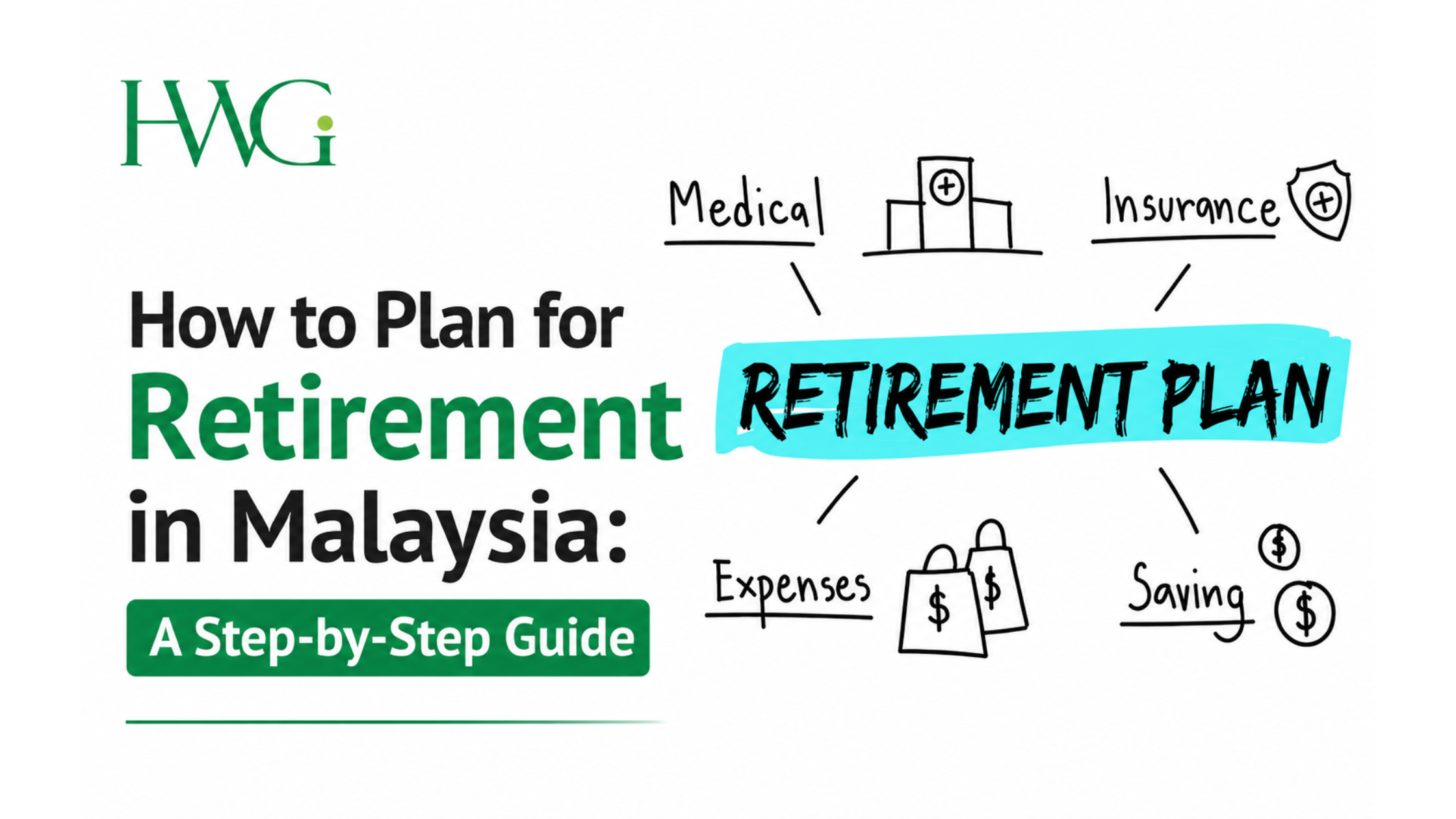

If you are learning how to plan for retirement in Malaysia, start with three questions: when do you want to retire, how much will you need each month, and how much have you already accumulated? From there, calculate your retirement savings gap and build a plan around EPF, supplementary savings, investments, healthcare, debt and future income. A clear retirement plan turns a distant goal into measurable actions you can review every year.
EPF’s Retirement Income Adequacy, or RIA, framework provides useful reference points for retirement planning in Malaysia. The key 2026 figures are summarised below, but your personal target should still reflect your lifestyle, healthcare needs and expected retirement period.
Retirement Planning Malaysia at a Glance

| Retirement reference | Amount |
| 2026 transitional Basic Savings at age 60 | RM270,000 |
| EPF RIA Basic Savings level | RM390,000 |
| EPF RIA Adequate Savings level | RM650,000 |
| EPF RIA Enhanced Savings level | RM1.3 million |
| Adequate retirement expenditure reference | About RM2,690 per month |
Source: EPF Retirement Income Adequacy Framework
Quick Retirement Planning Checklist
- Set your target retirement age and lifestyle.
- Estimate monthly retirement expenses.
- Check your EPF, PRS, savings and investments.
- Calculate your retirement gap and reduce expensive debt.
- Plan healthcare, retirement income and estate matters.
- Review the plan every year.
What Is Retirement Planning in Malaysia?

Retirement planning is the process of estimating how much money you will need after regular employment income ends, and building sufficient assets and income to support that period. In In Malaysia, EPF often forms the foundation, while PRS, cash savings, investments, insurance, and income-producing assets may support a broader plan. HWG Asia’s guide on the role of EPF in retirement planning explains how EPF fits within a wider plan.
How Much Money Do You Need to Retire in Malaysia?
EPF’s RIA framework uses RM650,000 as the Adequate Savings level at age 60, while RM390,000 represents Basic Savings and RM1.3 million represents Enhanced Savings. The Adequate Savings reference is based on about RM2,690 in monthly expenditure for a single elderly person in the Klang Valley under Belanjawanku 2024/2025 and a 20-year retirement period. Your own target may be higher or lower depending on housing, healthcare, family responsibilities, lifestyle and other income sources.
Someone spending RM5,000 a month will need a different plan from someone budgeting RM2,500. Use the EPF figures as benchmarks rather than fixed targets.
Step 1: Decide Your Retirement Age and Lifestyle

Start by defining your target retirement age, where you expect to live and the lifestyle you want to maintain. Consider housing, travel, family support and whether you expect to work part-time after leaving full-time employment. Retiring earlier gives your savings less time to grow and increases the period they must support you, so also review early retirement in Malaysia.
Step 2: Calculate Your Monthly Retirement Expenses

Build your retirement budget around expected spending rather than using a fixed percentage of your current salary. Include housing, food, utilities, transport, healthcare, insurance, leisure, family support and home maintenance, while keeping healthcare as a separate budget category. A useful starting formula is monthly retirement expenses × 12 × expected retirement years, then adjusted for inflation, investment returns and changing healthcare needs using references such as Belanjawanku.
For example, RM4,000 a month for 20 years equals RM960,000 before those adjustments. This gives you a starting target rather than a complete retirement forecast. Your final number should reflect your expected lifestyle and other retirement income.
Step 3: Check Your Retirement Assets and Calculate Your Savings Gap
Add up the assets you expect to use for retirement, including EPF, PRS, cash savings, fixed deposits, investment accounts and income-producing assets. Subtract this total from your target retirement fund to find your retirement savings gap. If your target is RM900,000 and your current retirement assets total RM350,000, your gap is RM550,000.
Retirement Gap Example
| Item | Example |
|---|---|
| Target retirement fund | RM900,000 |
| Current EPF | RM280,000 |
| Other retirement investments | RM70,000 |
| Current retirement assets | RM350,000 |
| Retirement gap | RM550,000 |
| Years until retirement | 20 years |
Once you know the gap, estimate the monthly or annual contributions needed before your target retirement age. Digital calculators can support this process, although results depend on the assumptions you enter. HWG Asia’s guide to digital tools for retirement planning in Malaysia provides additional methods for this calculation.
Step 4: Build an Emergency Fund and Reduce Debt

Keep emergency savings separate from retirement assets so short-term problems do not force you to draw from long-term savings. Focus first on expensive debt that consumes a large share of monthly cash flow, especially high-interest credit cards and costly personal loans. As retirement approaches, review mortgage and car commitments because large fixed repayments reduce the income available for daily living.
Step 5: Maximise EPF for Retirement Planning in Malaysia
Check your EPF balance with the relevant RIA reference levels, avoid unnecessary withdrawals and consider voluntary contributions when your cash flow permits. EPF currently sets accumulated voluntary contributions at up to RM100,000 per year across the relevant facilities. Self-employed people, workers without fixed income, and gig workers can also review i-Saraan, which currently provides eligible members a 20% special incentive of up to RM500 annually, subject to the scheme’s terms.
Step 6: Supplement EPF With PRS and Other Investments
A Private Retirement Scheme, or PRS, can be added to EPF through professionally managed funds with different risk profiles. Private Pension Administrator Malaysia states that eligible PRS contributions qualify for personal income tax relief of up to RM3,000 a year through assessment year 2030. Before choosing PRS or another investment, compare risk, fees, liquidity, diversification and how soon you may need the money.
Step 7: Plan for Healthcare and Insurance Costs

Healthcare is worthy of a separate retirement budget because unexpected medical costs can erode long-term savings. Look into medical insurance, hospitalization coverage, critical illness protection and the amount you could pay if an expense falls outside your policy. EPF also highlights healthcare, emergencies and inflation among expenses that may push retirement costs above baseline.
Step 8: Plan How You Will Draw Retirement Income

Reaching a target balance is only one part of retirement planning because you also need a plan for monthly income. Decide how much you expect to withdraw, which assets you will use first, and how much accessible cash you want for near-term expenses. Potential income sources may include EPF withdrawals, investment income, rental income, business income, and cash reserves, while any remaining invested assets should align with your need for stability and liquidity.
Step 9: Include Estate Planning in Your Retirement Strategy

Retirement planning should also address what happens to your assets if you die or become unable to manage your financial affairs. Review EPF and insurance nominations, prepare or update your will, identify beneficiaries and keep important financial records accessible to the right people. HWG Asia’s estate and retirement planning in Malaysia service explains how lifetime financial needs and the eventual transfer of remaining assets can be reviewed together.
Step 10: Review Your Retirement Plan Regularly
Review your retirement plan at least once a year and after major changes such as marriage, divorce, a new child, job changes, property transactions, serious illness or inheritance. Recheck your target, savings rate, investments, insurance and estate documents, then update your assumptions about spending and inflation. A plan created in your 30s may need changes by your 40s or 50s, so treat retirement planning as an ongoing process.
Common Retirement Planning Mistakes to Avoid
Common mistakes include starting too late, assuming EPF will cover every lifestyle, ignoring healthcare and inflation, carrying expensive debt and withdrawing retirement savings unnecessarily. Taking unsuitable investment risk can also affect the outcome.
FAQs About Retirement Planning in Malaysia
Q1: How much money do I need to retire comfortably in Malaysia?
A: There is no single amount that suits every retiree. EPF uses RM650,000 as its Adequate Savings level and RM1.3 million as its Enhanced Savings level at age 60, while Belanjawanku estimates about RM2,690 per month for a single elderly person in the Klang Valley. Your target should also consider housing, healthcare, lifestyle, inflation, and how long you expect retirement to last.
Q2: What is the best way to start a retirement plan?
A: Start by choosing your target retirement age and estimating your expected monthly expenses. Next, review your EPF, savings, PRS, and investments to see how much you already have. Compare this amount with your retirement target, then set a monthly or annual savings goal to close the gap.
Q3: Can I retire at 60 with RM500k in savings?
A: RM500,000 may be enough for some retirees, but it depends on your monthly spending, housing costs, healthcare needs, other income, and retirement duration. It is below EPF’s RM650,000 Adequate Savings benchmark. A fully paid home or additional income may help your savings last longer, while higher medical or family expenses may increase the amount you need.
Q4: Which part of Malaysia is best for retirement?
A: There is no single best place to retire in Malaysia. Retirees should compare housing costs, healthcare access, transport, daily expenses, proximity to family, and lifestyle preferences. The right location depends on your retirement budget and the type of lifestyle you want.
Build a Wealth Management Plan Aligned with Your Life Goals
Gain clearer direction, coordinated support, and access to suitable wealth planning with HWG.
HWG supports individuals and families across key financial needs, including:
• Wealth planning accumulation
• Estate planning
• Retirement planning
Where regulated advice or execution is required, services are delivered by appropriately licensed entities within the HWG group. HWG does not provide regulated financial advice or execute investments.
Take the Next Step
Contact HWG Malaysia Today
Got Inquiries? Please contact us or start a Conversation with HWG Greenie, our AI chatbot.
Visit and follow Our Social Media:
Website: https://www.hwg.asia/
Facebook: https://www.facebook.com/hwg.asia
LinkedIn: https://www.linkedin.com/company/hwgasia/
Visit Our Office:
Address: 42, Jalan BM1/2, Taman Bukit Mayang Emas, 47301 Petaling Jaya, Selangor
Email: customerservice@hwg.asia
Phone: 03-5569 9834
Download the HWG Go Apps (Available on the Play Store and App Store)
HWG Go: Available on both the Google Play Store and Apple App Store (T&C Available).
Disclaimer:
This article, published on this website, may be written or contributed by subject-matter experts or external writers. They are intended for general information and educational purposes only. HWG does not guarantee the accuracy, completeness, or timeliness of the information provided. Please note that the products, services or solutions in these articles may not be offered or provided by HWG. HWG shall not be held responsible or liable for any loss, damage, or issues arising from the use of, or reliance on such information.